As a follow-up to a previous blog, the city has posted Dr. Cal DeWitt's presentation on their website here.
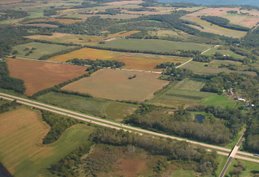
The slide below is my favorite showing the various layers of bedrock deposits in Dane County (top left is north). The two darkest layers are the thickest areas of the Eau Claire formation which comprise the best aquitard separating our upper and lower aquifers. As you can see, much of the county does not benefit from this layer of shale.
Saturday, February 23, 2008
Dr. DeWitt's Presentation Posted
Posted by
Terry Carpenter
at
11:00 AM
0
comments
Categories Cal DeWitt, Plan Comm Meetings, Water Resources
Tuesday, January 22, 2008
Wake Up Dane County!
Last Tuesday night the room was packed for Dr. Cal DeWitt's remarkable presentation which was entertaining, important, and memorable! If you missed it, you might catch the replay on FACTv.
I'm sorry Channel 15 news was unable to record the unveiling of Dr. DeWitt's latest research during his second presentation to the Plan Commission, which unfortunately was delayed for an hour in order to accommodate people there for other agenda items.
Eau Claire Aquitard and Buried Bedrock Valleys
During his presentation, Dr. DeWitt shared his remarkable and eye-opening discoveries, involving over 700 hours of research since his September 2007 presentation to the Plan Commission. He unearthed to the public, the secrets of the hidden bedrock valleys which lay beneath the surface of Fitchburg. The bedrock was created in layers by various sea deposits over millions of years including a series of deposits from the ancient "Eau Claire Sea."
These deposits of mud, silt, and sand form the Eau Claire Formation and it is the shale in this formation that forms a barrier (aquitard) that separates the upper and lower aquifers. Valleys, cutting through this bedrock, make it look much like the rugged, exposed topography of the driftless area to our west. And the Nine Springs bedrock valley cuts completely through the Eau Claire Formation. After these incisions, however, the valleys around here were filled in by the glacier (which also created a fantastic chain of lakes) and they now lie silently below us.
Through research of previous core samples taken from wells, Dr. DeWitt demonstrated that the aquitard is slowly reduced in thickness from Southwest to Northeast Fitchburg, where it thins as it approaches Lake Waubesa and then disappears completely. This results in a joining of upper and lower aquitards, making them one.
In Northeast Fitchburg, east to west along the 9 Springs E-way, and in much of Madison and Sun Prairie, there is a joining of upper and lower aquifers, and this may more fully explain the reason for Madison's many water quality/contamination problems.
Caution is Urged
Dr. DeWitt strongly urged against drilling any new wells in or near areas where the aquitard is lacking and suggested that Fitchburg steward the land by "sleuthing" the science (hydrology, geology, hydrogeology, limnology) of the area carefully in future planning.
He warned against relying on current groundwater models, when considering new development (such as the Northeast Neighborhood). While these models are helpful for many areas where bedrock is fairly uniform, they do not account for the cutting through of the Eau Claire aquitard by the Nine Springs Bedrock Valley or the thinning of the Eau Claire Shale to zero in the northeast.
Other models being used for runoff similarly must be used wisely; and their current use does not adequately address phosphorus loading inputs. He suggested that unless care is taken to prevent the eutrophication of Lake Waubesa, by reducing the phosphorus runoff below levels found in present and future developed neighborhoods, Fitchburg would eventually pay in increased taxes for future remediation to restore the watershed.
Rosanne Lindsay
Fitchburg
- - - - - - - - - - - - - -

Terry Carpenter
Fitchburg
Posted by
Terry Carpenter
at
10:30 AM
0
comments
Categories Cal DeWitt, Plan Comm Meetings, Water Resources
Monday, January 14, 2008
Surprise Guest Remains a Mystery
This is a longer version of the Letter to the Editor, Capital Times
To be published 1/15/2008
Who could the “Special Guest” be at the top of the agenda? What forwarding-thinking person is Mayor Clauder going to present? I’ve never seen the Mayor so excited about anything. But, then, I’ve mostly seen him at Council or Plan Commission meetings. But wait. This IS a Common Council meeting and he’s still excited about something.
During the Mayor’s melodramatic and “suspenseful” introduction, I can’t help but watch the clock because time is valuable and I came here to observe the Fitchburg Common Council meeting. It’s been 3 minutes and he’s still playing his mystery game. So far, we know it’s connected to the Packers because he unfurled a giant poster containing the familiar helmet. We can also see a green and gold bobble-head doll perched near the Mayor’s seat (which remained in the camera’s view the entire night).
After 5 minutes of introduction, the moment arrived. There was no curtain so special guest John O’Neill appeared out of the wings of FACTv’s offices (affectionately referred to as “tent city” because of the tarps protecting their equipment from a leaky roof). Covered from head to toe in an elaborate green and yellow costume, “Saint Vince” strode across the Council Chambers carrying a staff topped with a cheesehead wedge and took the microphone from our beaming Mayor. O’Neill explained his unusual Packer Fan history including his costume (a tribute to “Saint" Vince Lombardi) and inclusion in the NFL Fan Hall of Fame.
Yes, this really happened and I had the misfortune to witness it for a mind-boggling 20 minutes at the beginning of the Common Council meeting on Jan. 8th.
I don’t think I was the only person to be dazed and confused by this display of Football Fever. I noticed a few other somber or perhaps puzzled faces in the audience. They probably came to express their concerns to about official agenda items. They were made to wait through 20 minutes of sports trivia before the Council could get on with business. I doubt that these concerned citizens appreciated the extra time spent waiting their turn.
I can’t help but wonder why Mayor Clauder believed that this was an appropriate venue for such a guest. Clauder mentioned that Green Bay and Ashwaubegon councils both invited the famous fan. He mentioned that he’s personally known O’Neill for a long time because he lived in Fitchburg for many years. But I still don’t see why Fitchburg needs to follow the lead taken by Green Bay. The two cities are quite different. We don’t even have a stadium much less one filled with Packer fans year after year. I haven’t a clue as to why Ashwaubenon is now setting a precedent for Fitchburg to follow.
Now, before any of you send me hate e-mail for being anti-Packers, I should tell you that “Saint Vince” seems to be having a great time as he raises money for charity by charging people to have their picture taken with him. This is all well and good… in the right time and place. I believe that a Fitchburg City Council meeting is not the right place. And if it were the right place, the priorities around allocation of time are still wrong.
And there’s also the issue of fairness and equity. Many people, including me, find it quite difficult to get more than 3 minutes of face time with the Council or the Plan Commission without being interrupted by “Are you almost done?” But I’m not in the NFL Fan Hall of Fame like O’Neill who had no such problem.
I have to question the priorities because I know that Dr. Cal DeWitt, a UW Professor who has devoted his life to studying and teaching complex ecosystems, was given just 30 minutes to present important research at the Plan Commission meeting Tuesday, Jan. 15th when he could have spent much more time if permitted. Dr. DeWitt has built an international reputation through his involvement with projects and conferences relating to global climate change and other ecological issues. His interdisciplinary experience has allowed him to connect some important dots in Dane County and we need to hear what he has found.
Do you see anything wrong with the judgment over at City Hall when the Mayor can allocate 20 minutes for stories about the Packers while Dr. DeWitt is only allowed 30 minutes for a presentation about the importance of buried bedrock valleys, missing aquitard and how these affect our groundwater system?
I do. Fitchburg’s Council, Committees and Commissions have important work to do. Their decisions impact the daily lives of current and future residents. Although I enjoy the occasional bit of humor at city meetings, wasting 20 minutes on sports trivia is a disservice to our community.
Terry Carpenter
(Disgusted in) Fitchburg
Posted by
Terry Carpenter
at
12:30 PM
0
comments
Categories Cal DeWitt, Council Meetings, Letters to Editor, Plan Comm Meetings
Thursday, January 10, 2008
How Will Measures Be Enforced?
Expanded version of Jan. 10, 2008 Letter to Editor, Fitchburg Star
Submitted by Phyllis Hasbrouck
Chair of the West Waubesa Preservation Coaliton
“Just Trust Us”
The main message that I heard from developer Phil Sveum and his team on Dec. 18 was “Just trust us.” They painted a picture of a “green development” in the Northeast Neighborhood, but with no real substance. They are “looking at” encouraging homebuyers to use efficient plumbing fixtures, limit lawn watering, create and maintain raingardens, and use rain barrels. They assure us that when they complete their CDP (comprehensive development plan) it will have measures adequate to protect Lake Waubesa, Swan Creek, the springs and the groundwater.
Should the Plan Commission just take their word for it? How many times have cities been left holding the bag when a stormwater plan went bad? Developers sure are good at sweet talking, but once they finish the project, they are done, and all problems are left to the city.
Can Neighborhood Associations be Depended on?
All of the neighborhood-wide water-saving and stormwater control features of the Sveum plan depend on a Neighborhood Association to carry them out, and that’s a real weakness. It’s hard to find people willing to put in the volunteer hours for the good of the whole neighborhood. Harlan Hills (which was built by Sveum to be an “environmental development”) has a neighborhood association, but it hasn’t stopped people from using the pesticides that Sveum said would be banned. People have mowed down prairie and incorporated pieces into their yards, and concerned residents were told that suing their neighbors is the only way they can get the covenants enforced.
It’s very easy to say, “the outlot raingardens, the repair and plowing of the alleys, and the greenways will all be managed by a dues-collecting neighborhood association,” but the reality may be quite different. A recent Capital Times article talked about the many area residents who buy homes without realizing that their street is private, and that they’ll have to pay for its upkeep. What if new residents of the NEN can’t or won’t keep up the raingardens, alleys and greenways? Will Phil Sveum step in and pay? Will the city? Or will the environment have to pay? I understand that Fitchburg has never allowed private streets. I hope that they stick to their principles when it comes to private allies, greenways, and infiltration features.
What makes anyone believe that the people who move into such a development will be interested in conserving tap water or maintaining raingardens? Congratulations to Commissioner McNally, who brought a sense of reality back to the discussion when he asked whether we could really count on all of these ambitious plans happening!
A Memorandum is not a Promise
The Ruekert-Mielke stormwater report was a list of goals, with no concrete suggestions to describe how the goals would be met. The Montgomery Associates Memorandum on water is a slight improvement. It describes the general sort of techniques that they plan to use, e.g. “providing multiple points of treatment and infiltration of runoff as close to the impervious surfaces as possible.” But we are told to wait until they have a comprehensive development plan to see exactly what kind, how many, and where such measures will be. Can it be that this is the accepted way of approving developments – to just take the say-so of people who have every reason to skimp once they have the approval?
Rob Montgomery, Sveum’s water expert, said “Those [municipal] wells draw water from the lower aquifer relatively isolated from the upper aquifer, and also draw from a wider region of Fitchburg and areas to the west.” People who attend or watch the next Plan Commission meeting at 7 p.m. in City Hall on Jan. 15 will learn that this is not so, when they hear Dr. Cal DeWitt speak on buried bedrock valleys.
The memorandum says that “Water draining off the Par Fore site will be managed to exceed state and local ordinance criteria for water quality, peak discharge rates, and runoff volumes.” Once again, we are told to just trust them. Everything will be done according to the law. But does that mean that it won’t harm the environment? The environment has been gravely harmed by development, and presumably most of that development was done within the law. We need some leadership by people willing to defend the resources that will sustain our grandchildren!
Groundwater, Lakes and Phosphorus
Rob Montgomery’s conclusion was that “placing consideration of the Northeast Neighborhood ‘on hold’ because of regional groundwater management concerns is not warranted. We suggest that an appropriate approach for the Planning Commission is to approve the neighborhood plan including an objective of maintaining groundwater recharge, and recommending appropriate municipal water supply conservation practices.” Translation: “Just write down that it would be good for people to save water and let rainwater infiltrate, and let us go about our business.”
It was encouraging to hear Commissioner Kinney ask Rob Montgomery how he could ensure that the water going in to Swan Creek would be both cleaner and of the same volume post-development. I hope that all the commissioners will be asking skeptical and probing questions, as they are responsible for the welfare of the entire community.
Some commissioners may think that the question of phosphorus has been laid to rest with City Engineer Paul Woodard’s calculations that post-development the NEN will contribute less phosphorus to surface waters than it presently does. While this may be true, (a schedule of corn, corn, and soy results in a lot of phosphorus runoff) it is not the relevant question to ask. Because Lake Waubesa is already partly eutrophic, a large reduction in phosphorus loading is needed, not a small one. Small scale, organic farming could be the best option of all for protecting and restoring Lake Waubesa, and it should be studied.
Workforce Housing and the Future of Fitchburg
Kudos to Alder Allen and Mayor Clauder for bringing up the issue of workforce housing. This is a huge need, but it won’t be met unless the city insists on it. Our proposal for the Northeast Neighborhood, which we will present to the Plan Commission in Feb., contains 30 units of workforce housing, for the farmers, teachers and entrepreneurs who will run the school of organic farming, the farmers market, and the Bike and Breakfast that we envision. The people who will be attracted to inhabit the NEN if our vision is realized will definitely be interested in and dedicated to saving water, infiltrating rainwater, stopping soil loss, rejecting pesticides, and creating a vibrant, closely knit community.
I hope that the Plan Commission and Common Council will remember that the choice before them is not between Mr. Sveum’s proposal and the worst possible development. The choice is between Mr. Sveum’s proposal, just leaving the land in agriculture, or endorsing our plan to preserve our lakes and groundwater while producing healthy food for the community.
Posted by
Terry Carpenter
at
12:30 PM
0
comments
Categories Cal DeWitt, Letters to Editor, NE Neighborhood Plan, NEN, NEN Stormwater Plan, Plan Comm Meetings, Water Resources
Development Threatens Water Quality, Rural Character
Slightly revised version of Jan. 10, 2008 Letter to the Editor, Fitchburg Star
Submitted by Ed Korn, Fitchburg
Concerning the proposed development in the rural area of Fitchburg east of County MM and north of Lacy Road known as the Northeast Neighborhood. This parcel of undeveloped land abuts the Town of Dunn, a community that has worked hard to retain its rural characteristics.
As one example of the effort by the Town of Dunn to control the impact of development there was years ago an informal agreement between the Town chair and Fitchburg mayor that an undeveloped buffer would be left between Fitchburg and Dunn. The proposed Northeast Neighborhood completely ignores that agreement to the detriment of the kind of community Dunn is trying to maintain.
The shallow southern two thirds of Lake Waubesa is flushed and kept clean by three creeks which draw a significant quantity of their water from the Northeast Neighborhood. Changing the land use from agricultural to suburban will likely have a detrimental impact in those creeks and the already marginal water quality of Lake Waubesa.
Leap frog development which this is, is not appropriate land use. It's expensive to provide the municipal services of police, water, sewage, public transportation, and fire safety. Swan Creek is only fractionally built out let alone Green Tech Village. There is also a significant quantity of appropriate land closer to Fitchburg's central core that at this time is far better suited for urbanization. I think the quality of life of both the Fitchburg and Dunn residents would be better served if the Northeast Neighborhood retains its rural character.
Posted by
Terry Carpenter
at
12:29 PM
0
comments
Categories NE Neighborhood Plan, NEN, Plan Comm Meetings, Water Resources
Northeast Neighborhood Poorly Planned
Jan. 10, 2008 Letter to the Editor, Fitchburg Star
Submitted by Holly Adams, Fitchburg
I am a resident of the Northeast Neighborhood, and I was hoping that Sveum’s plan for the forests and fields that surround my home would impress me with planning, innovation and forethought. Unfortunately, the plan failed on all three counts.
The neighborhood is not well planned out. The neighborhood is not really a neighborhood, just a large cluster of homes clumped together. There is nothing to build a sense of community, no center, no focal point, no main streets, just winding roads jam-packed with single family homes, condos and duplexes.
I was hoping for more innovation in the design. I was hoping for something that would make Fitchburg unique or identifiable. Instead, I saw a bedroom suburb, the same as I see around Sun Prairie, DeForest, and Cottage Grove. Putting garages in the backs of lots and houses close together will only encourage people to walk if there are places to walk to. However, everything for these families will be a car trip away. A carton of milk, a teacher’s conference, returning a book to the library and a swim lesson will require cars to dart out of this neighborhood in four different directions.
With all the work that has been done to study I thought there would be more forethought in the plan. The last thing I expected to see was a repeat of the Swan Creek neighborhood, except with more homes jammed in. The Northeast Neighborhood was picked as an area to study for future development because of its proximity to the GreenTech development and to the rail corridor that runs parallel to it. No one knows for sure what is going into that rail corridor, but everyone seems sure we want to develop along it. Of course, if it is high speed rail, the chances that there will be a stop between Oregon and Madison are slim, but that matters not to the people who want to tear up the fields and forests to build acres upon acres of vinyl-sided homes in every shade of taupe known to man.
The city of Fitchburg and the School District of Oregon will bear the costs of this development. The city will have to pay for fire and police protection in this remote corner of Fitchburg, the cost of maintaining the roads and alleys that will crisscross the cornfields, and the cost of leapfrogging urban services over vacant land while land in the existing urban services area goes undeveloped. The school district will bear the cost of bussing kids seven miles each way to school; and the cost of building new schools and spaces for children who live on the far outer edge of the district.
But more costly still is the cost all of us will bear as we continue to chew up field and forest for pockets of development. The cost to our lakes, springs, streams and well water. While Fitchburg and Oregon can tax all of us more to help defray the costs to them for services, there is no amount of money anyone can extract that will recompense us when we have drained our wells dry, or killed our lakes.
I grew up in the Northeast neighborhood. I followed the trails through the woods that led through the meadows and out into the fields that are soon to be torn up. I climbed up the trees, and helped friends build tree forts in the oaks that bent out over the corn fields below. When we had the chance to move back to this wonderful corner of Fitchburg, we jumped at it. We watch the turkeys and the deer during the day, and wait for the flying squirrels to soar in at night. I love the parts of Fitchburg that are forward thinking, progressive and unique. I just wish my own neighborhood was going to stay in that part of Fitchburg, and not become part of the poorly-planned, mundane, environmentally-lethal suburbia that one developer envisions.
Posted by
Terry Carpenter
at
12:29 PM
0
comments
Categories Letters to Editor, NE Neighborhood Plan, NEN, Water Resources